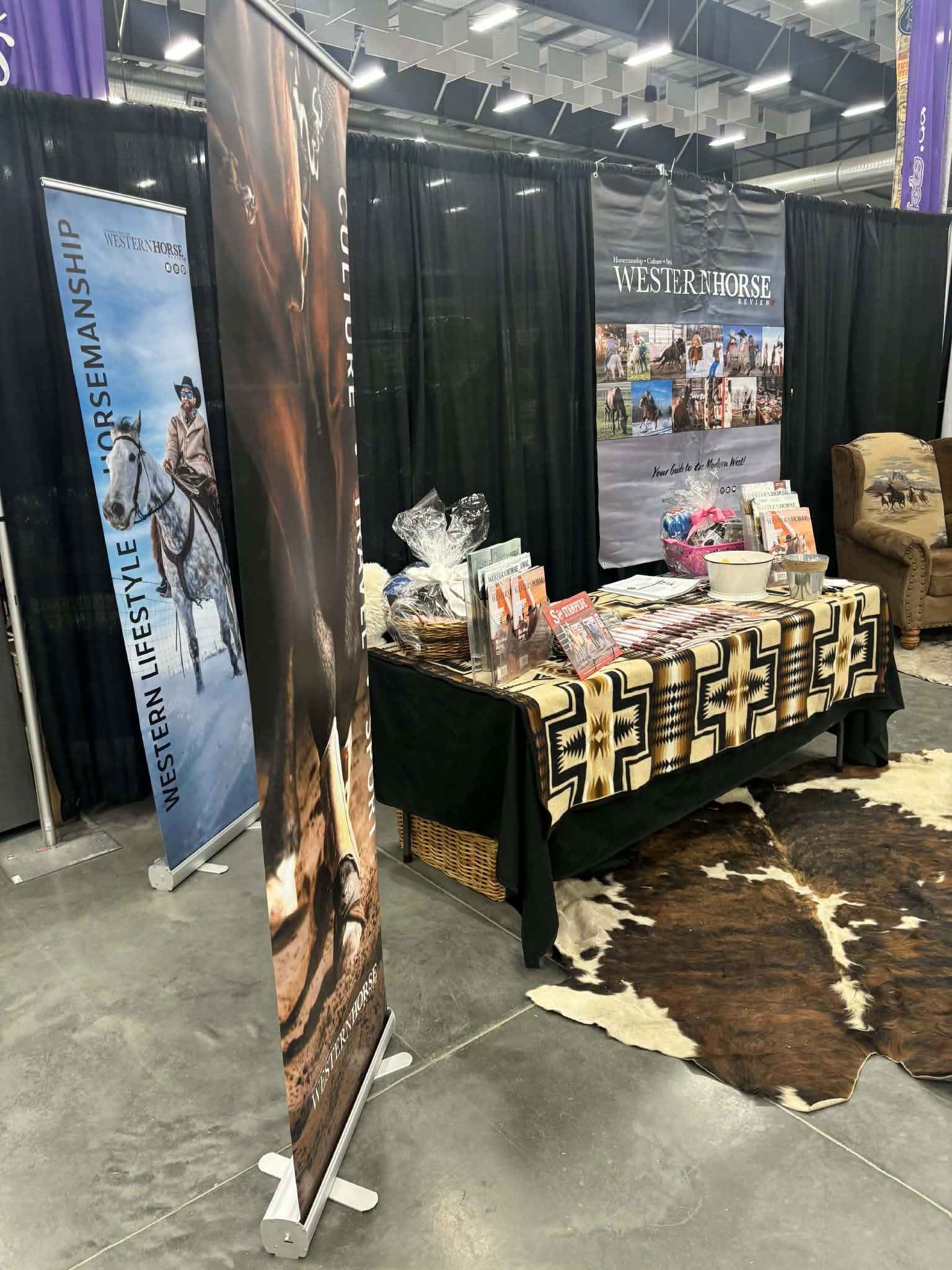
If you’re heading to the Horse Expo in Red Deer this year, make sure to add one more stop to your list—our booth! We’ll be here all weekend, ready to connect with fellow horse lovers, answer your questions, and share what we’ve been working on. Whether you’re a seasoned rider, a weekend trail explorer, or just passionate about all things equine, we’d love to meet you.
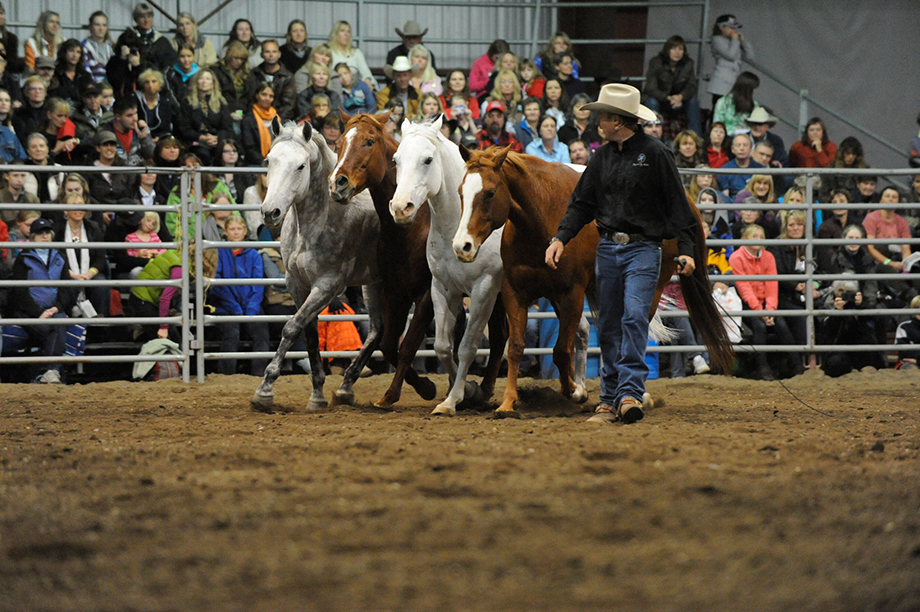
Jonathan Field is a highly acclaimed horseman, much sought after as a clinician and trainer
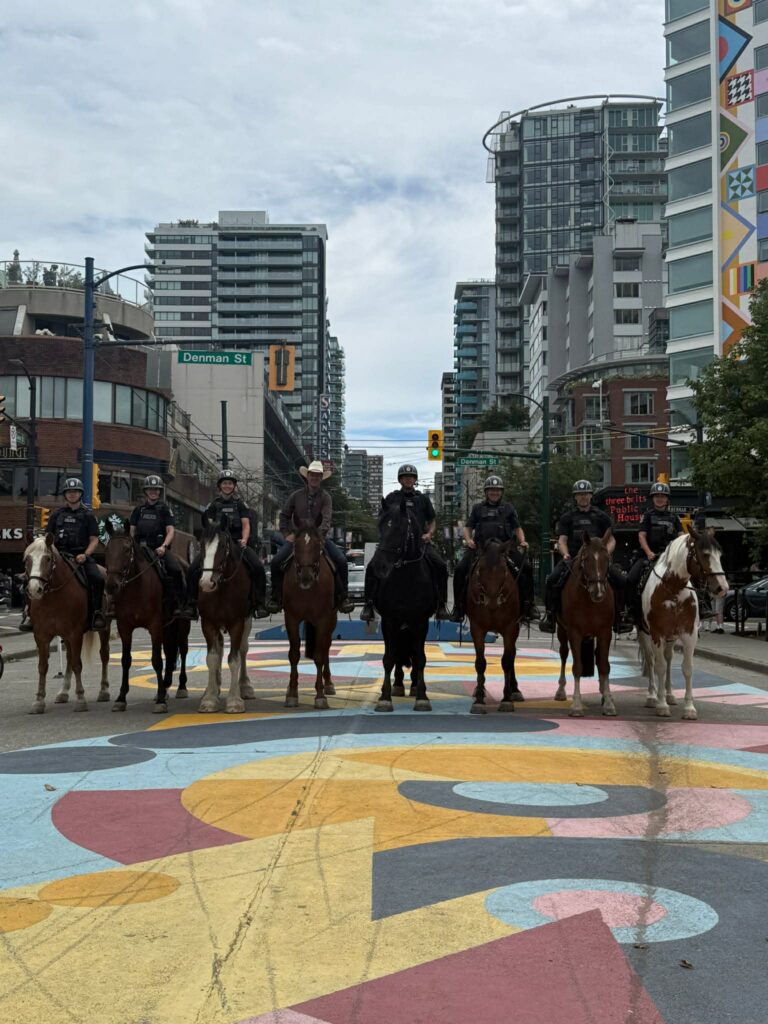
We have a special guest stopping by the Western Horse Review booth (#4509) at 2 pm today! Jonathan Field will be coming to say Hi, chat and sign autographs! Be sure to come and grab our newest issue, where we feature Jonathan’s incredible work with the Vancouver Mounted Police Unit.
The Vancouver Mounted Police Unit, featured in our latest issue, on stands now!
A recent rule change regarding colour genotype results has been accepted by the American Quarter Horse Association.
For decades, the colour listed on an American Quarter Horse Association (AQHA) registration certificate has been based solely on what the eye can see. But a recent rule change spearheaded by AQHA Director Ryan A. Fleetwood of Champion, Alberta, is ushering in a new era of accuracy, transparency, and genetic proof.
At the AQHA Convention in March, 2025, Fleetwood announced the successful passage of a proposal that will allow AQHA members to optionally include UC Davis colour genotype test results on the master report for any registered horse. While these results won’t appear directly on the certificate, they will be stored in the official AQHA database, where anyone can verify them.
A Long-Awaited Solution
“This new option won’t solve all the problems,” Fleetwood admits. “But it will allow those of us who wish to have indisputable evidence in the form of genotype on our horses to have it on official AQHA paperwork.”
The rule passed through AQHA’s Stud Book & Registration Committee – a body that oversees all rule changes related to registration, including signatures, cloning, and embryo transfers. Fleetwood, who became a Director in 2022 and joined this key committee in 2024, authored the proposal himself.
“I originally asked for genotype results to be printed on the back of the certificate,” he explains. “But real estate on the form made that unworkable. The compromise was to include it on each horse’s master report in the AQHA database.”
Fleetwood is already looking ahead: “Next, I’d like to see it integrated into the new Quarter Horse Resource pedigree database along with any health panel test results or genetic testing that may also have been done.”
Genotype vs. Phenotype: Why It Matters
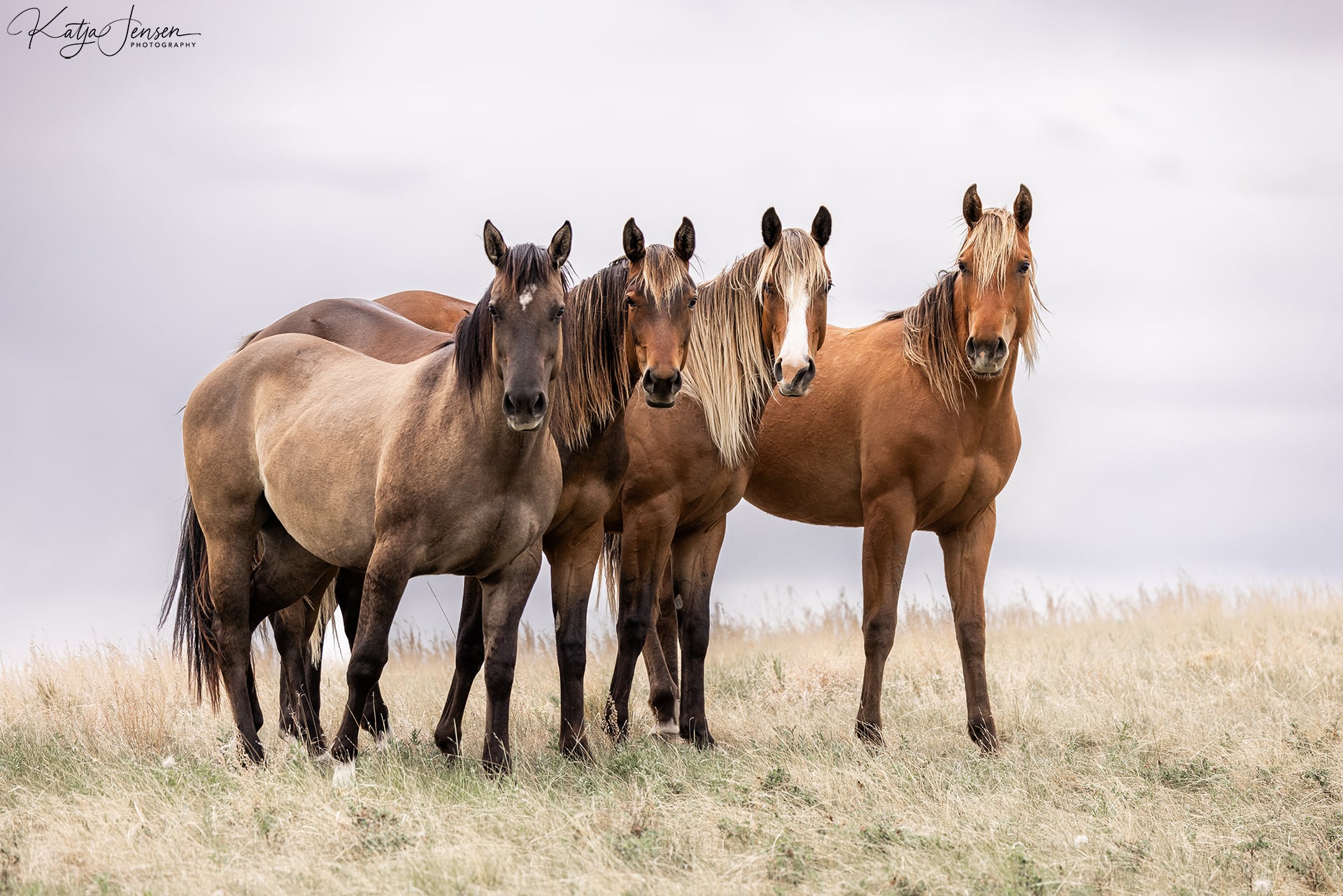
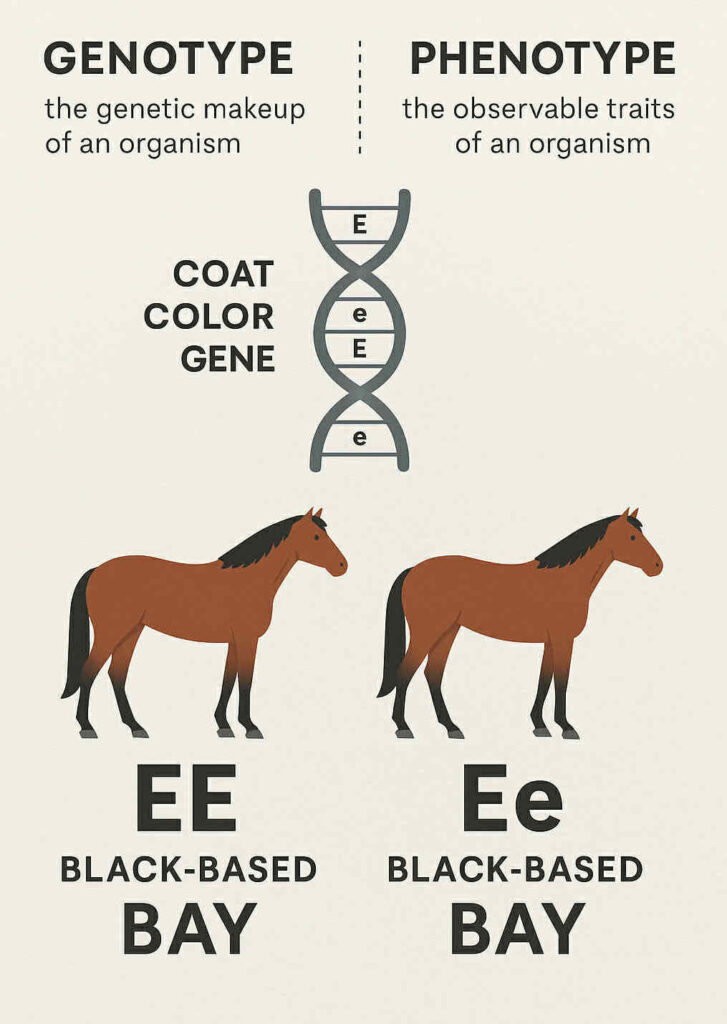
Traditionally, the colour printed on AQHA papers is based on phenotype – what you can see. But a horse’s genotype (its actual genetic makeup) can tell a very different story.
“You can have two horses that both look like bays,” Fleetwood explains, “but one may carry two copies of the black gene, while the other only carries one. That’s important information for breeders trying to predict colour outcomes in foals.”
Understanding genes like extension (E/e) and agouti (A/a) makes a big difference. Agouti, for example, controls where black pigment shows up on the body, and without it, a bay horse would be black. But you’d never know agouti status just by looking.
“This eliminates the need for speculation,” says Fleetwood. “There’s no arguing with genotype. Phenotype is subjective; genotype is fact.”
A bay horse must carry one copy of extension in order to have black pigment. But a horse that carries one copy and a horse that carries two copies can look exactly the same.
A Tool for Breeders, Buyers, and Beyond
Fleetwood emphasizes that this new feature is completely voluntary, but for breeders and buyers who care about colour genetics, it’s a game-changer.
“Up to now, if you wanted to prove a horse’s colour genetics, you’d often use an external lab report – basically just a PDF,” he says. “Now, we’re bringing that information inside the AQHA. If a buyer wants to verify what a seller or breeder is saying about a horse’s colour genetics, they can look it up in the official record.”
UC Davis is AQHA’s designated lab for this testing. Their results can be matched with the horse’s DNA already on file, offering an extra layer of protection. And while the current AQHA registration certificate will still list phenotype on the front, this new master report addition means that genetic test results can now travel with the horse in a verifiable way.
Silver Lincoln, a silver bay stallion owned by Fleetwood Farms.
The Governance Behind the Change
Fleetwood is a self-proclaimed “horse lover and politics fan,” and AQHA’s democratic structure is part of what fuels his passion.
“It’s a member-driven association. Any member can submit a rule change, addition, or deletion. Those proposals go to their respective committees and are debated at the annual convention. Any AQHA member in attendance can participate in those discussions. It’s grassroots and in-person. If you care enough to show up, you can shape the future of the breed.”
That process is exactly how this rule passed: through committee, general membership, directors’ meeting, and finally, executive review. But crucially, proposals from the Stud Book & Registration Committee cannot be vetoed by AQHA’s Executive Committee – acknowledging the deep technical expertise required in this area.
“It may take a decade to see the results of these rule changes,” Fleetwood says. “They’re not just administrative. They change the direction of the registry.”
What Comes Next
Fleetwood hopes this is just the beginning. He’s already thinking about future rule proposals and invites Canadian and international members to reach out with their ideas.
“There are only two things we test for now: genetic disease and colour,” he says. “But who knows about the future? Some say we will be able test for things like disposition. And when we can, that data will be housed and displayed by AQHA.”
For Fleetwood and many others, this new rule isn’t just about paperwork – it’s about preserving the integrity of the breed and empowering breeders with the best information science can offer.
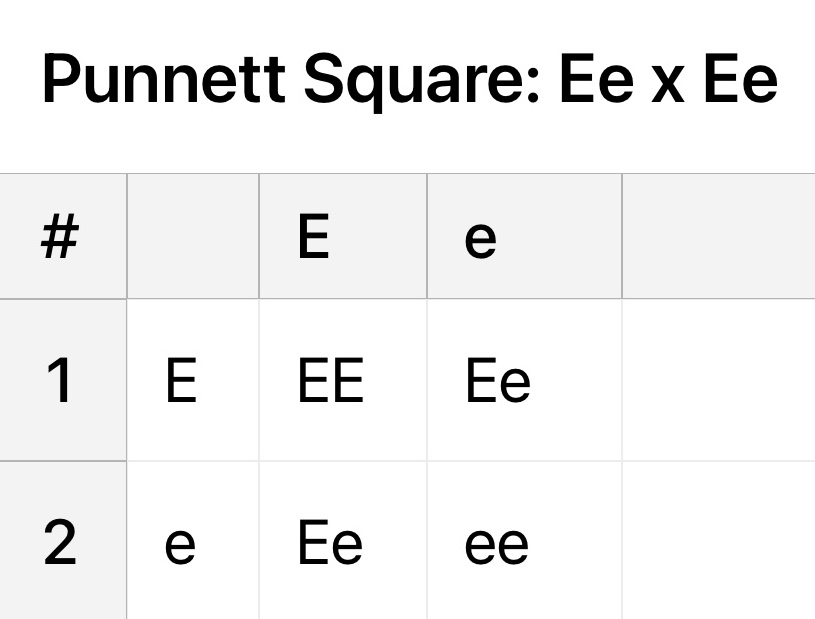
This Punnett square shows the possible offspring genotypes from two heterozygous (Ee) black-based horses.
Genotype vs. Phenotype in Horse Coat Colour
1. Genotype = the genetic makeup of an organism (what genes it carries)
• These are alleles on specific genes, like:
Extension (E/e): Determines black pigment production
* E = black pigment can be produced
* e = only red pigment (no black)
* EE = black-based horse
* Ee = black-based, carries red
• ee = red-based (e.g., sorrel, chestnut)
Agouti (A/a): Controls distribution of black pigment
* A = restricts black to “points” (mane, tail, legs) → bay
* aa = black distributed over whole body → black
* Has no effect on red-based horses (ee), although they do have an agouti status.
2. Phenotype = the horse’s observable traits (what you see)
• This includes coat colour, but it can be misleading:
* Two horses might both look bay but have different genotypes.
* A horse that is Ee Aa and one that is EE Aa will look the same but pass on different colour traits.
3. Why this matters in breeding:
• Genotype determines what colours a horse can produce in offspring, which is crucial for breeders.
• You cannot tell genotype by sight alone – especially with red-based horses or subtle modifiers (like silver, champagne, or dun).
Therefore:
• A bay horse is E_ A_ — meaning it has at least one E and one A.
• Whether it’s EE or Ee, it still looks bay, but EE can only pass black, while Ee can produce red foals if bred to another carrier.
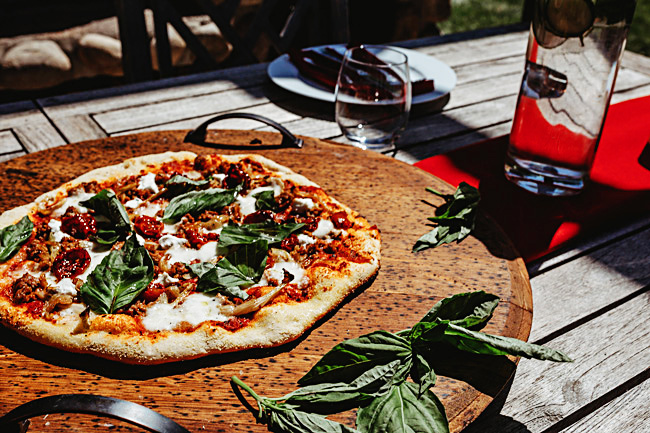
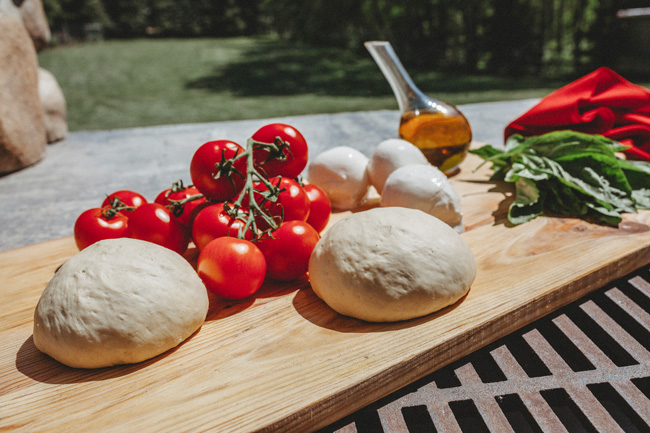
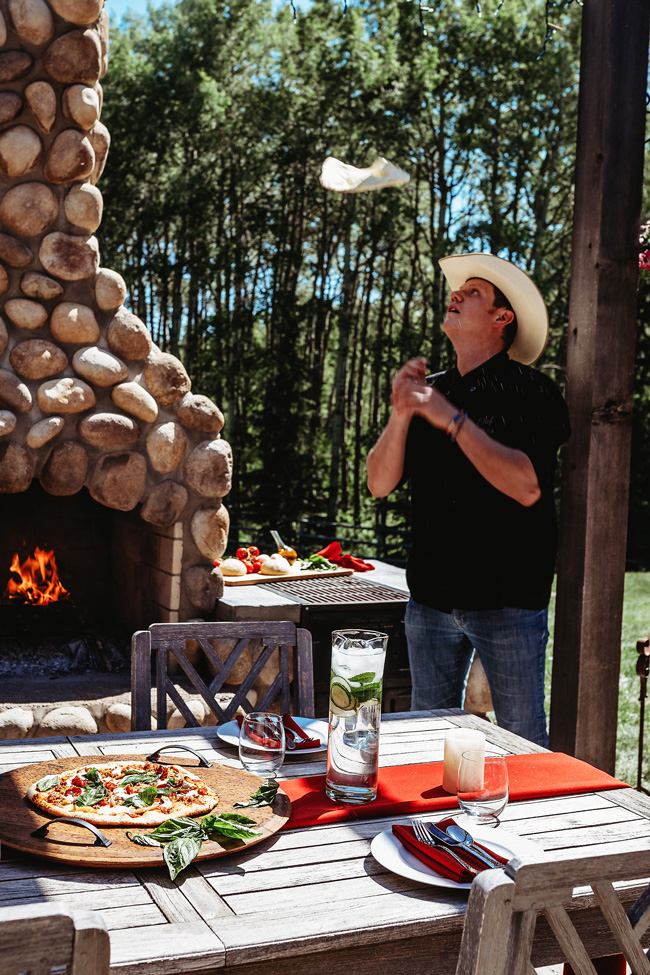
With all these plus temperatures we’ve been having lately, Canadians are itching to get out on the patio. Here is a drool-worthy homemade pizza, to enjoy with friends.
Dough:
3 and ¼ cups All Purpose Flour
2 tsp. Active Dry Yeast
1 tbsp. Salt
2 tbsp. Honey
1 cup warm Water
¼ cup dry, White Wine at room temperature
2 tbsp. Extra Virgin Olive Oil
Method – In a large bowl, combine flour, yeast and salt and mix well. Make a well in the center of the dry ingredients and add the warm water, wine and oil. Using a wooden spoon mix the wet ingredients into the dry until the mixture is stiff to stir. Then mix with your hands in the bowl until the dough comes together and pulls away from the bowl. Lightly dust a work surface with flour. Remove dough from the bowl and knead for five minutes. Oil a large clean bowl and place the dough ball inside. Cover with a damp towel and allow to proof in a warm place. Let it double in size.
Sauce:
100 oz can of Diced Tomatoes
1 Onion, thinly sliced
5 cloves Garlic, chopped
1/2 cup Dry Oregano
1 tbsp. Salt
1 tbsp. Pepper
1 cup Olive Oil
Method – Heat olive oil in sauce pot. Sauté onions, garlic, salt , pepper and oregano for about three minutes. Add the tomatoes and cook for two hours at a low simmer. Stir occasionally with a twist to help break up the ingredients as they cook.
Roasted Fennel:
1 Fennel bulb
1 tbsp. Olive Oil
Method – Thinly slice the fennel. Sauté in frying pan until tender. Then place in a 400-degree oven for about 10 minutes.
Cheese:
Fresh buffalo mozzarella and fresh goat cheese (chevre). Bocconcini cheese made with cows milk will also work.
Sausage Meat:
3 lbs. Ground Pork
3 tbsp. Red Wine Vinegar
1 tbsp. Salt
1 tbsp. Black Pepper
1 tbsp. Garlic Powder
1 tbsp. Onion Powder
1 tbsp. Whole Fennel Seed
2 tsp. Sweet Smoked Paprika
2 tsp. Chili Flakes
1 tsp. Brown Sugar
1 tsp. Dry Oregano
Method – Mix all ingredients together. Mince for 10 minutes to ensure all spices are evenly mixed.
Building the Pizza
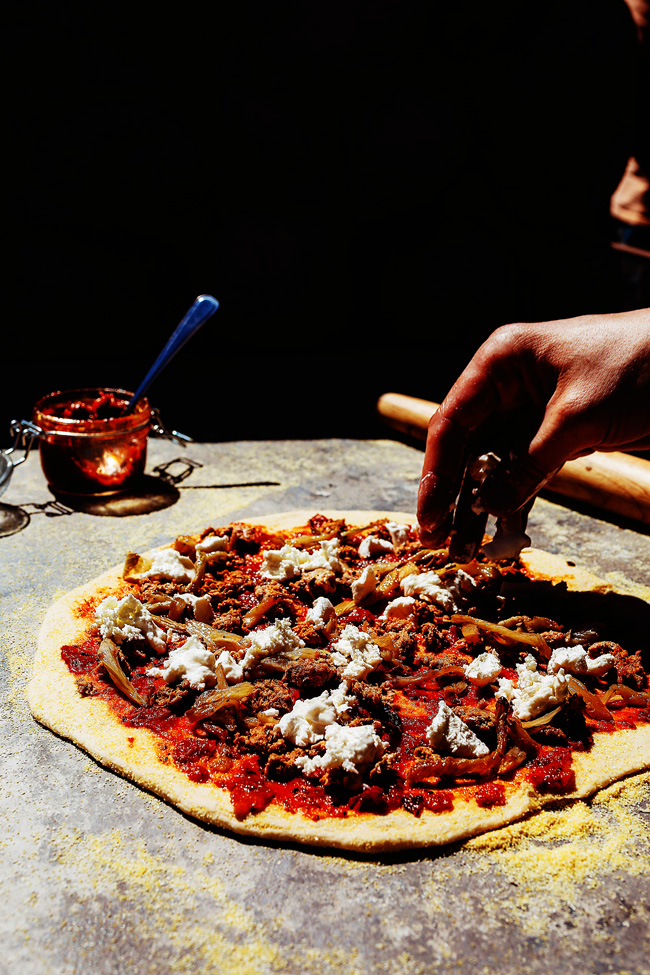
Portion the dough into 10 oz. portions and form onto balls. Let proof for another hour. Dust work surface with corn meal or flour to aid the rolling process. Roll your dough out into a circle. A 10 oz. dough should make a 10-inch pizza.
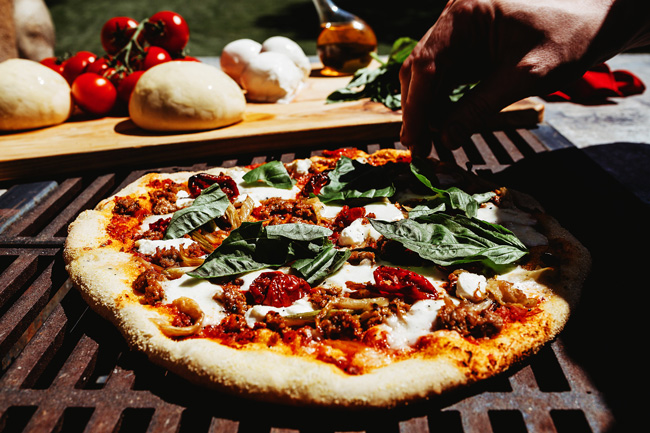
Sauce your dough. Add fennel and sausage. Tear the cheese into smaller pieces and place randomly on the pizza.
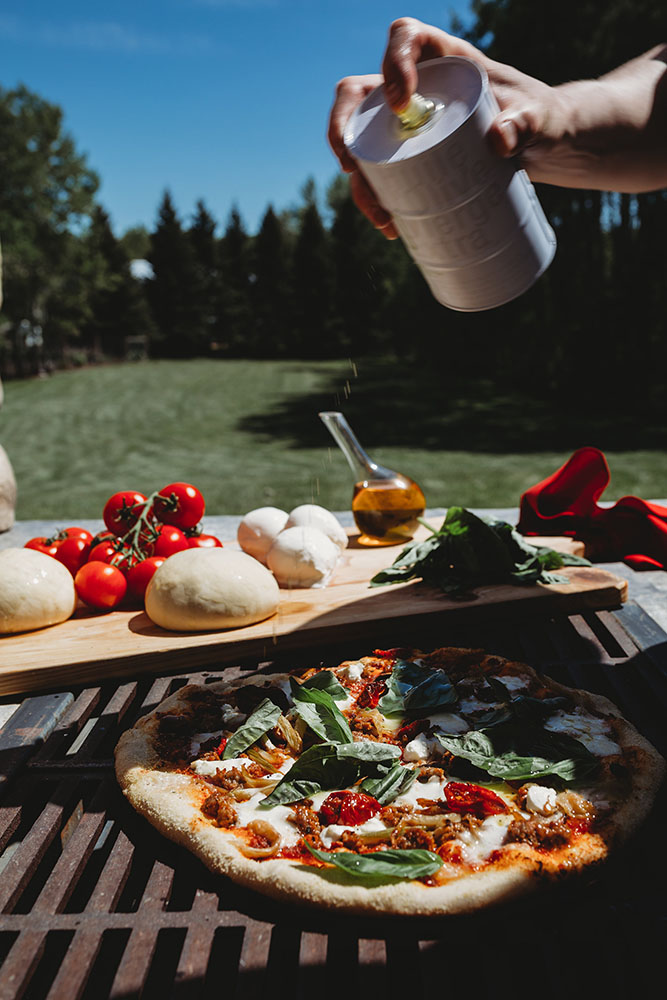
Use a pizza stone to cook your pizza. Allow the stone 10 minutes to heat up in the BBQ or oven before placing the pizza on it to cook. Slide your pizza paddle under the dough and transfer it to the hot pizza stone. If your use a BBQ, it should be set to 500 degrees. Your pizza will take between five and ten minutes to cook properly. It is ready when the crust is brown.
Once the pizza is cooked, top it throughout with fresh basil leaves. Drizzle with olive oil.
Enjoy!
* Thank-you to Tudor Stables and Connie and Andy Cicoria for allowing us to shoot this recipe on their beautiful outdoor patio!
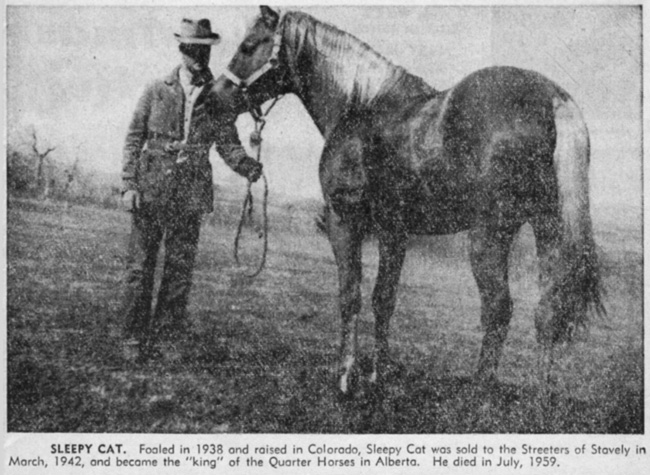
He was a dun-colored paragon of athleticism, beauty and charm, and was single-handedly credited for “…bringing back the Quarter Horse industry to life in Alberta,” as stated by a yellowed Calgary, November 28, 1959, newspaper archive of The Herald Magazine.
Foaled in 1938 in Colorado, Sleepy Cat was imported by brothers Jac and Allie Streeter of Stavely, Alberta in March of 1942. According to the first edition of The Butte Stands Guard, a historical book from the Stavely, Alberta area, this stallion was the first ever, registered Quarter Horse in Canada. There’s no doubt that following his importation into the country, Sleepy Cat clearly played a significant role in the Canadian Quarter Horse industry. In fact, The Herald Magazinewent so far as to praise this influential Canadian sire for the probability that one day he would likely “…take the same position as Old Sorrel holds in the Quarter Horse story in the United States.”
Sleepy Cat was a versatile stallion who bore the American Quarter Horse Association registration number 620. He was a son of Red Dog (AQHA #55) by Ballamooney, and out of Fatima (AQHA #58), by Old Sheik. Sleepy Cat’s lineage traces back to the immortal beginnings of the AQHA and some of the most famous names in the blue book of Quarter Horses. Through circumstances, he is also linked to the original forefathers of the association – the gentlemen who first brought the AQHA registry to fruition.
SLEEPY CAT. Foaled in 1938 and raised in Colorado, Sleepy Cat was sold to the Streeters of Stavely in March 1942, and became the “king” of the Quarter Horses in Alberta. He died in July 1959.
Sleepy Cat was foaled in Whitewater, Colorado and was raised by Jack Casement, a prominent breeder of Quarter Horses and a most influential founder of the AQHA. Jack was involved with the AQHA from its earliest, most primitive beginnings. According to Volume 1 of the AQHA Stud Book and Registry, it was the dream of the late William Anson (Christoval, Texas) to record the origin and attributes of the Quarter Horse breed, and it is a well-known fact that Dan Casement of Manhattan, Kansas also “contributed to the general store of knowledge concerning these horses.” However, it remained an “untouched field” until the writings of Jack Casement (son to Dan), and Robert M. Denhardt of College Station, Texas, “drew the spotlight of public attention to the Quarter Horse.” Their articles to various magazines “found a surprising response among breeders and users of Quarter Horses throughout the west.”
Subsequent to this, the first serious discussion of a Quarter Horse organization was held in 1939. An informal meeting that included Denhardt among others, “formed the nucleus of an ever-increasing group of Quarter Horse enthusiasts and on behalf of this group a general invitation was extended to all interested parties for a meeting to be held in Fort Worth on March 15th, 1940, during the annual Fat Stock Show.”
On March 14, 1940, a preliminary meeting was held where both Dan and Jack attended and agreed to help with the preliminary work involved in the “foaling of such an organization.” After the official meeting was adjourned on the eve of the following day, it was reconvened as the first meeting of the American Quarter Horse Association and both Casements were elected to the newly appointed board of directors – Dan as an Honorary Vice President and Jack as a Director.
Back to Sleepy Cat. Jac and Allie Streeter were the sons of Harry and Mary Streeter. The Streeters had purchased the land that would become the “Streeter Outfit” in 1919, near Willow Creek, Alberta. It had previously belonged to James Ford. Harry was a long time aficionado of horses and can be credited with the production of one of the first indoor rodeos in Canada which he put on in 1929 at the Stavely, Alberta, skating rink. Additionally, he often held two-day rodeos on their ranch during the 1930s. Harry then turned to racehorses in the 1940s – Thoroughbreds, Arabians and Quarter Horses – and owned one of the largest racing stables in western Canada until he passed away in 1949. Harry’s sons had purchased the ranch from him in 1946.
Both Jac and Allie followed closely in their father’s footsteps and were excellent horsemen. When they found out the good horse, Sleepy Cat, was at Jack Casement’s place, they jumped in a truck and brought him home to Stavely. Both the paternal and maternal sides of Sleepy Cat’s pedigree could be traced to the Steel Dust legacy and the stallion would offer much to the Streeter breeding operation. Steel Dust was a Quarter Horse “type” foaled in 1843 who attracted much attention in the southwestern states as a sire of running and cow horses. Sleepy Cat inherited the fabled Steel Dust profile – the smooth and compact shape, short back and deep barrel – without falling heir to Steel Dust’s single flaw, a bulging jaw. Sleepy Cat’s head was more refined and charming, and he possessed a mind and temperament to match. He had “an ideal disposition – mild and tractable as a breeding or working animal and highly intelligent.”
Sleepy Cat earned equal credentials in the show pen as he did as a sire. At the 1945 Calgary Stampede, he was declared Champion Rope Horse – winning on the same day Jac and Alice Smith were married. Sleepy Cat won many laurels over the years, appearing in numerous cutting contests and roping events. He was sire to at least 200 foals during the course of his life in Alberta and was often used for the breeding of Campbell mares in the Ad Day Quarter Horse operation, owned at the time by Alf Campbell of Alberta. The Herald Magazine credits this mating as that “…which brought the Quarter Horse Industry back to life in Alberta and established it in the almost fabulous manner we know today.”
Sleepy Cat was held in such high esteem as a sire that often he was claimed as the sire, or grandsire of horses who never so much as nickered “over the fence to him.” Of some 200 foals, only 28 were ever registered with the AQHA and all are now deceased. However, of those 28 horses was Black Gnat, a black gelding owned by Coy and Casement of Buffalo, Wyoming. Black Gnat was the only documented performing offspring of Sleepy Cat and achieved his Open Performance Register of Merit in 1952. Many of the other listed registered horses were owned by Streeters or Campbells. Sleepy Cat was known to ranchers as a “solid gentleman,” and often stood to outside mares, so it’s likely the rest of his foals exceeded in ranch duties, cow horse and roping events and were scattered across western Canada.
In July of 1959, the much-loved stallion passed away quietly at age 22 in Streeter’s pasture. Gone but never to be forgotten, the horse’s epilogue would read, “undoubtedly it was Sleepy Cat and his offspring which stimulated the first [Canadian] interest and activity in the Quarter Horse business…”
He was purchased for $80 on his way to a slaughterhouse and became an international show jumping champion.
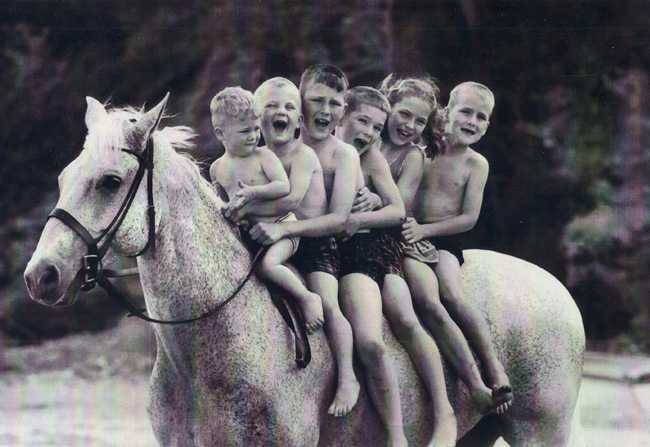
The de Leyer kids swimming aboard Snowman. Photo by Bill Ray Photography
He was waiting to be loaded onto a trailer on his way to the slaughterhouse when destiny intervened. Harry de Leyer, an escapee from Nazi Germany had fled the country to the US and was looking for a quiet lesson horse for riding instruction. The big grey was the last of three horses left at the auction – so de Leyer took a leap of faith. The horse was purchased for the sum of $80 and as he was unloaded, the snowflakes glistened on his white coat. It was then that a little child whispered, “He looks like a snowman.” The name stuck.
A couple of years later, Harry sold Snowman to a neighbour who wanted a quiet plow-horse. Somehow Snowman knew he was indebted. He and de Leyer had developed what later became an inseparable bond, and he would jump high fences to return to de Leyer’s stable. The higher the fence, the higher Snowman jumped and soon he was winning prestigious jumping classes. He became a jumping champion, but had the heart and the soul of a family pet. He stood 16 hands high and could jump over six feet. He never spooked and was amazing with children.
In 1958, Snowman won the American Horse Shows Association Horse of the Year, Professional Horseman’s Association Champion and the Champion of Madison Square Garden’s Diamond Jubilee – competing against some of the world’s best. He jumped fences, seating benches, other horses and he jumped his way into people’s hearts.
The US Show Jumping Hall of Fame inducted Snowman in 1992. Together, theirs was a Cinderella story on two levels. They were survivors on separate roads leading to destruction. Snowman was heading for the slaughterhouse, while Harry de Leyer was escaping Nazi Germany. de Leyer had aspired to be on the Dutch Olympic Team, but with the invasion of Holland, he never had a chance – that is until his encounter with Snowman. Theirs was a partnership cemented by the heart.
“Indeed, horses have the hearts of warriors and often carry us into and out of fields of personal battles. Those who know them understand how fully a horse can hold a human heart.”
– Lauren Davis Baker
Italian race horse breeder, Frederico Tesio once said, “A horse gallops with his lungs, perseveres with his heart, and wins with his character.”
Renowned horse trainer and mentor Pat Parelli instructed,“A horse doesn’t care how much you know until he knows how much you care. Put your hand on your horse and your heart in your hand.”
Literally and anatomically defined, the heart is “a hollow muscular organ of vertebrate animals that by its rhythmic contraction, acts as a force pump maintaining the circulation of the blood…”as defined by the Webster Dictionary.
The horse heart is not dissimilar. It functions in a similar manner on a larger scale. Both are four chambered, located in the between the lungs and ribs and above the diaphragm, and both have two main functions: to pump oxygen and nutrients into the bloodstream and through the body.
Interestingly, in contrast to its size, the adult equine heart beats 30-40 beats per minute, while the smaller human heart beats about 60 times per minute. The equine heart is more efficient, and it’s equine “power-train” increases rapidly to an imposing 240 beats per minute when galloping. The efficiency is also remarkable, returning to its resting rate very quickly. Strenuous exercise creates the ability to deliver high volumes of blood for extended periods of time – as much as seven times that of the human heart.
Physiologically speaking, the equine heart has evolved to support intense and varied levels of athleticism, and it is often said that a horse has more than one heart. Like other mammals, a horse has only one physical heart – however, speaking in terms of cardiovascular efficiencies, the frog in each hoof pumps the blood back up to the heart from its lower legs, with every step taken. A grounded hoof expands and fills with blood, and as it leaves the ground, it contracts, sending the blood back to the heart. It is estimated that as a horse walks, it pumps a litre of blood through its body approximately every 20 meters or so, figuratively supporting the concept of more than one heart.
Yet, there is more to the equine heart than just that. Many horses have the physiological characteristics to win and to persevere. Secretariat and Phar Lap are two examples of exceptional race horses with hearts that were larger than the normal, (Secretariat’s weighed 22 lbs., while Phar Lap’s weighed 14 lbs.) Then there are the horses who succeed by sheer will and determination. This definition of “heart,” although intended to describe a very real characteristic in the horse, is immeasurable. Take Canada’s Big Ben for example; he survived two colic surgeries, a car accident, competed three times in the Olympics and won more then 40 Grand Prix titles with his rider, Ian Miller.
In this next series of blogs, we’ll share some other stories of many remarkable equines who due, either to the bond formed with their person or their exceptional courage, are in a league of their own because of their hearts.
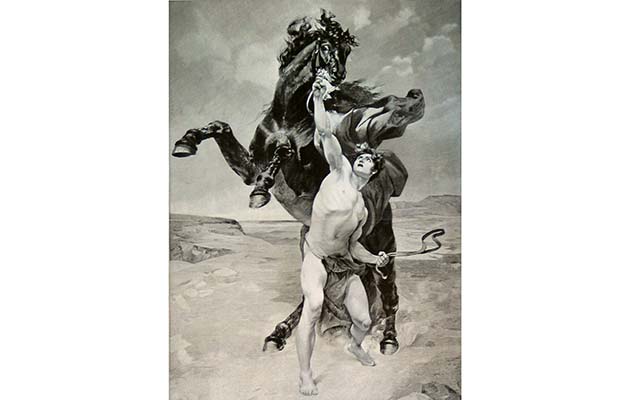
The taming of Bucephalus by Andre Castaigne (1898–1899). Image source: WikimediaCommons.
Bucephalas (the steed of Alexander the Great)
One of the most famous stories of classical antiquity (the Greco-Roman era), is that of Bucephalas, a massive black stallion with an oversized head. He was said to have a large white star on his forehead (brow) and blue eyes, developed from the best of Thessalian cavalry lineage. The Thessalian cavalry had been formed previous to the reign of Philip, father of Alexander the Great, however, it was Philip’s enhancement of it, that made the cavalry and its horses, such a formidable force.
It was the Greek historian, Plutarch, who chronicled that when Alexander was about 12 or 13-years-old, a horse was brought to King Philip from a herd by a neighbouring breeder, Philoneicus of Thessaly. He was priced about three times the norm (thirteen talents! or about $4 Million dollars today), and described as wild and unmanageable, rearing up against any and all who tried to manage him. Alexander’s father instructed the breeder to take him away.
Alexander, however, saw a noble creature – branded on his haunch with the figure of an ox-head (one of three common brands in ancient Greece).
He challenged the handlers, calling them spineless. His father admonished him, asking, “Do you reproach those who are older than yourself, as if you were better able to manage him than they?”
Alexander responded, “What an excellent horse do they lose for wont of address and boldness to manage him!”Then he approached the horse. Realizing he was facing away from the sun, and spooking at the unfamiliar noises and the sight of his own shadow, Alexander turned him the opposite direction, spoke quietly to him, then gently gathering the reins, calmly mounted him. They were one.
From that day forward, they were inseparable. Alexander was the only one who could ride him. Together in battle from Greece through Persia, and into India, Bucephalas was a much-beloved war-horse.
At one juncture, after Alexander defeated Darius III of Persia in the Battle of Gaugemela, Bucephalas was stolen while Alexander was away on excursion. Alexander was so incensed, he threatened to kill every inhabitant and lay the countryside to waste if his horse was not returned. He was, with a heartfelt plea for mercy.
Although some dispute the cause of Bucephalas’ death; battle wounds vs. old age, Plutarch quotes an historian who accompanied Alexander to war. Onesicritus cited the horse as having died of old age after the Battle of Hydaspes River (326 BCE) placing Bucephalas at approximately 30 years of age. Alexander was so distressed, he named one of his captured cities, Bucephala, on the west bank of the Hydraspes River in modern day Pakistan. He is believed to be buried in the modern-day town of Jalalpur Sharif.
Notwithstanding his legendary status as a warrior, his legend grew in context with that of Alexander’s. According to one story, previous to his last battle, Bucephalas paired with multiple wild mares in the Middle East and Asia, fathering a breed of rare and supernatural species – that of the mythical unicorn.
Gerry Hansma is a true, Canadian treasure. Specializing in cutting horses, Hansma has been inducted into the National Cutting Horse Association (NCHA) and Canadian Cutting Horse Association Rider Halls of Fame. Along with his wife Sandy, he is also a 2007 Canadian Supreme inductee into the Stallion Breeders Hall of Fame. Hansma possesses $1.89 M in Equi-Stat earnings, has coached numerous non-pros to championships and has been fortunate to bring many horses up through the ranks to major victories.
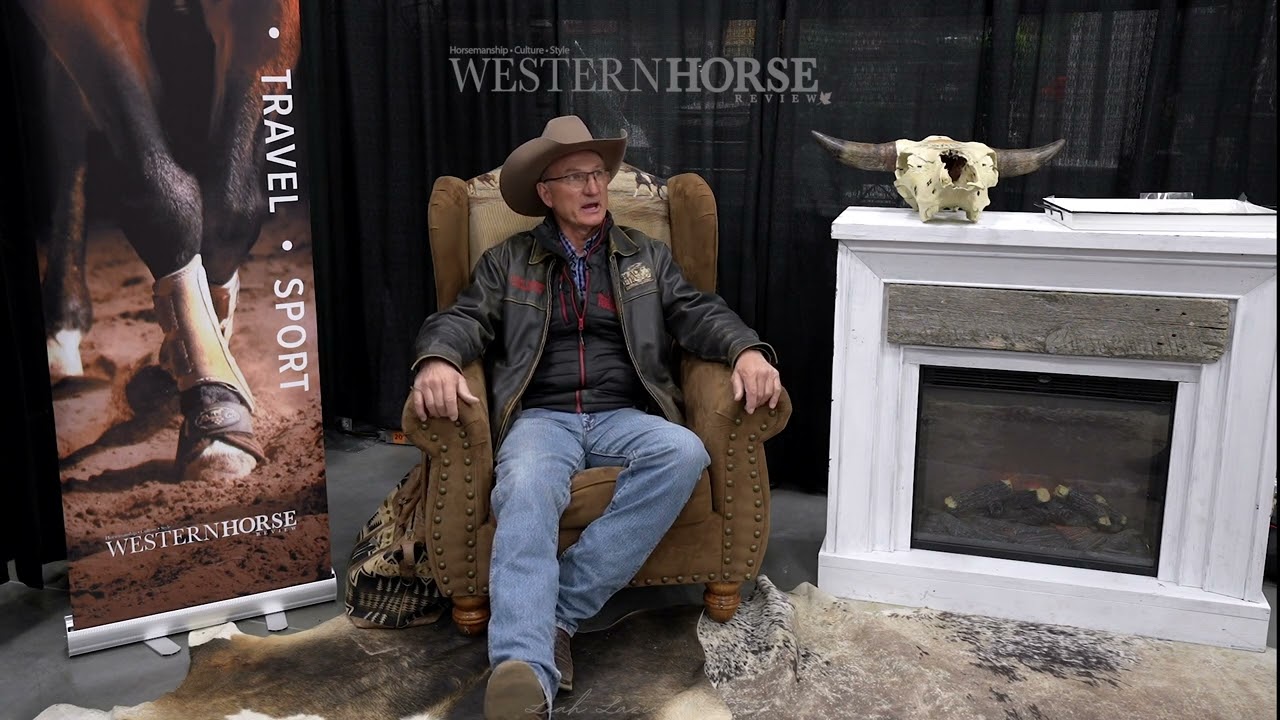
Western Horse Review had the opportunity to have a fireside chat with Hansma at the 2024 Horse Expo, where he conducted three days of cutting clinics for the public.
Here, Hansma shares insight for prospect shopping, the future of the horse industry and much more!
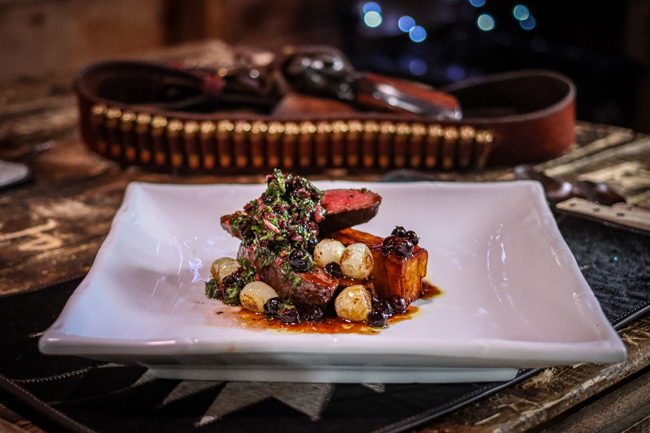
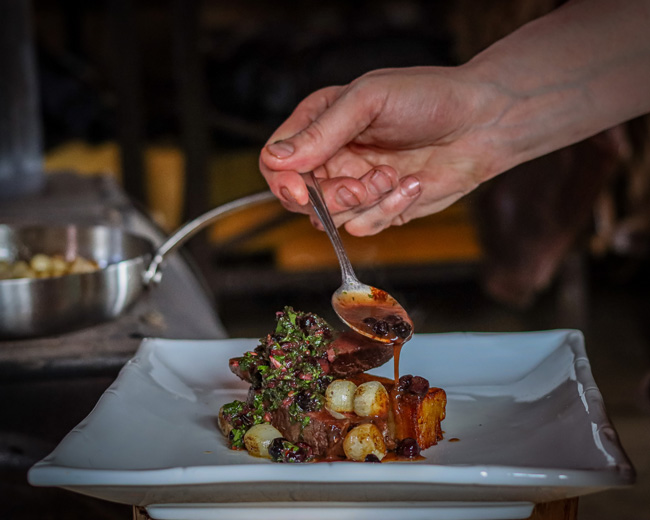
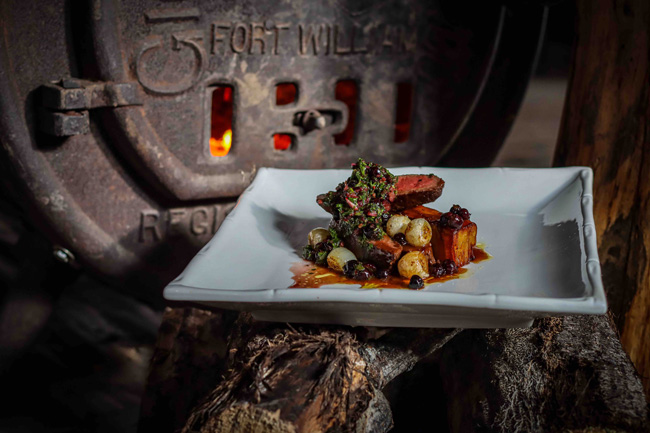
Served with crispy potato pavé, roasted pearl onions, and Saskatoon berry chimichurri – this melt-in-your-mouth dish is hearty and will allow you to savour the hunt, long after the season has ended.
Venison is one of the leanest, high in protein and most economical meats available – especially if you live with an avid hunter. This exquisite dish takes venison tenderloin to a new level and plated atop the most elegant scalloped potatoes (although not exactly, we’ll get into that later…) this meal will leave everyone satisfied and asking for more.
Potato Pavé
Pavé, is a French word for “paving stones” and as the potatoes are prepared for this dish and sliced into rectangular portions, thus the recipe name Potato Pavé. This side dish is similar to a refined version of scalloped potatoes and requires two days to complete. As such, this part of the meal is the first component to make.
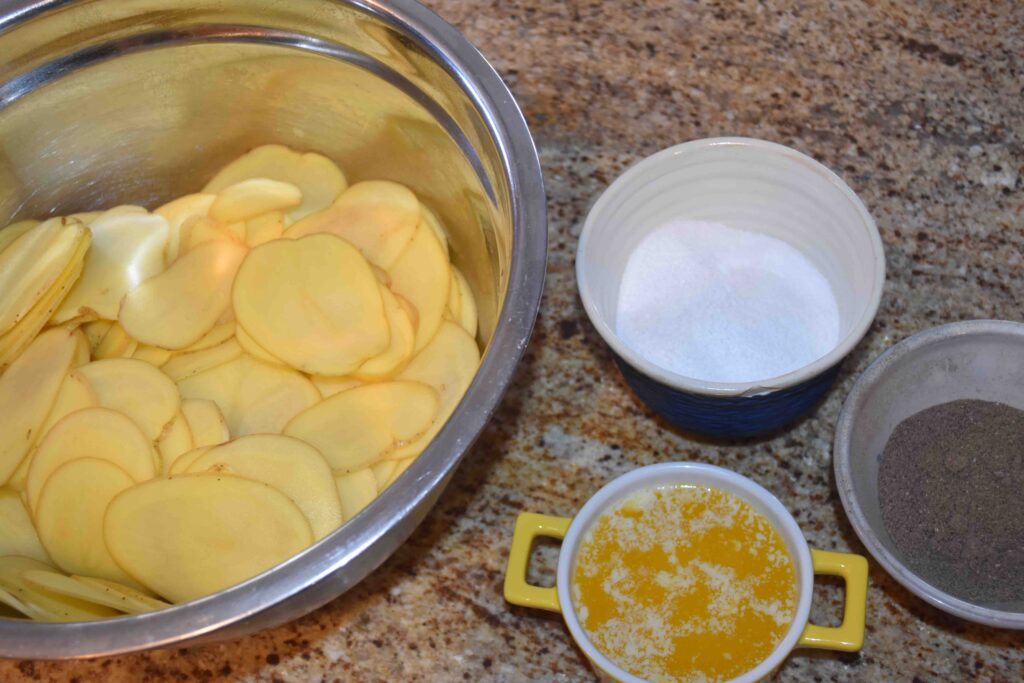
Ingredients:
3 lbs. Yukon Gold Potatoes
2 Tsp Kosher Salt
2 Tsp Ground Black Pepper
4 oz. Fat of Your Choosing (Duck, Goose, Beef, Olive Oil, or Butter) and Melted
Canola Oil for Frying
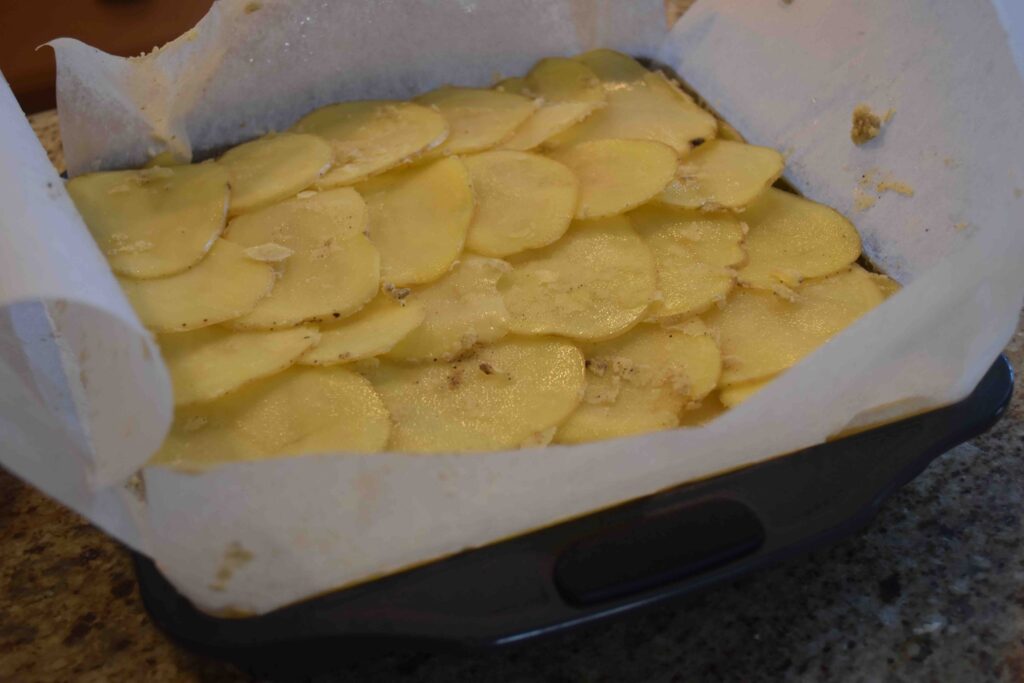
Once the potatoes are layered, bake them for three hours.
METHOD
1) Wash and peel potatoes.
2) Using a mandolin, slice the potatoes lengthwise to about 1/16th of an inch.
3) Place the potatoes in a bowl. Toss with fat, salt, and pepper.
4) In a loaf pan, lay down the potato piece by piece. Evenly layer until all the potatoes are used.
5) Preheat oven to 250-degrees Fahrenheit.
6) Bake the potatoes for three hours.
7) Remove from oven, cover with parchment paper, place another loaf pan on top and place weight onto the top of the loaf pan. The weight can be anything – canned vegetables, actual weights, or even rocks.
8) Place the weighted potato dish in the fridge overnight.
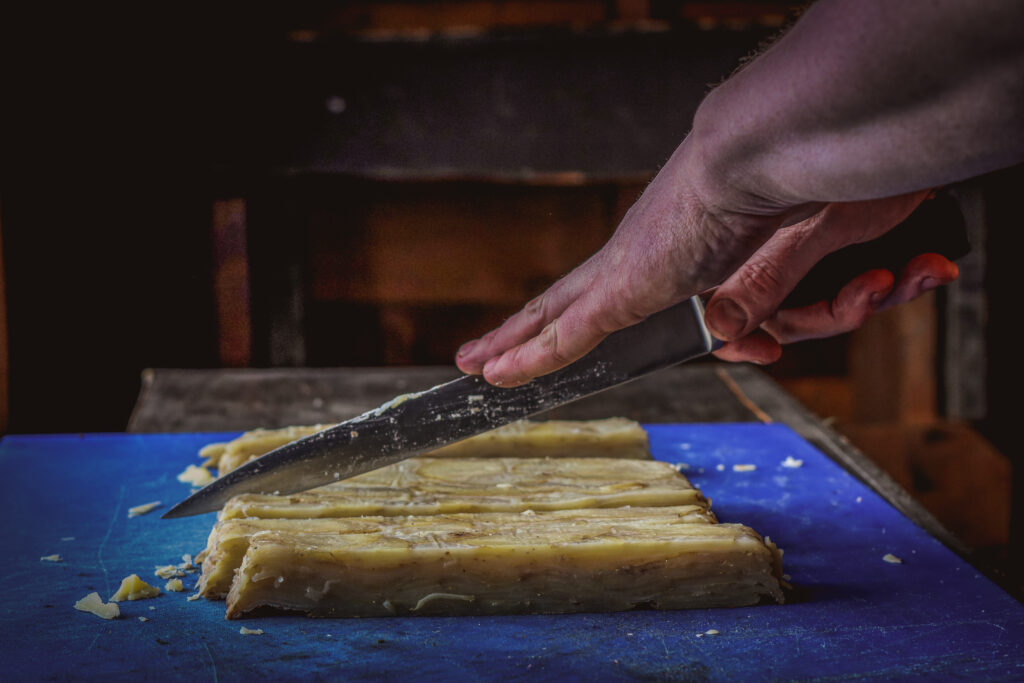
9) The next day, cut the potato side dish into desired portions. For this recipe, we did a two-inch length with a 1-inch width slice of potatoes.
10) Heat oil to 350-degrees Fahrenheit. Fry the potato slices for three to five minutes each.
11) Remove from oil and season with a pinch of salt.
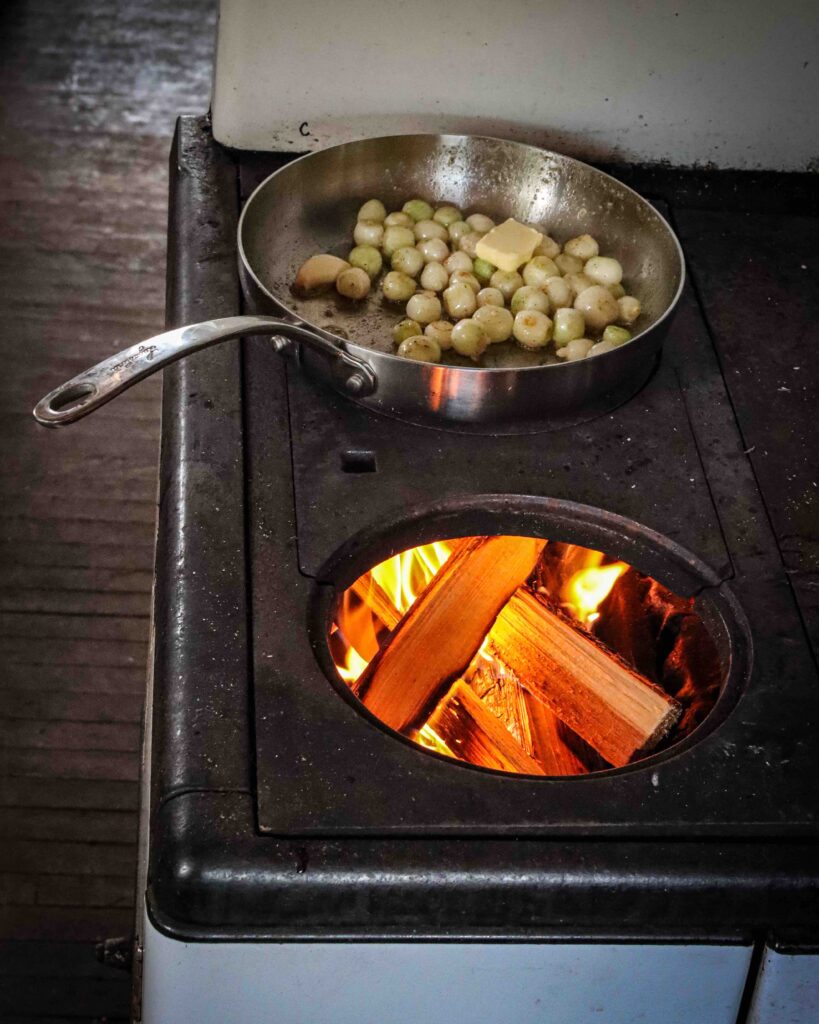
After they are prepared, cut your Potato Pavé into slices.Pearl onions, cooking on a wood stovetop.
Pearl Onions
Ingredients:
8 oz. Pearl Onions, Peeled
1 Tbsp Olive Oil
1 Tsp Fresh Thyme Leaves
1 Pinch of Salt
1 Pinch of Ground Black Pepper
METHOD
1) Toss onions with oil, thyme, salt, pepper.
2) Pre heat oven to 400-degrees Fahrenheit.
3) Place onions in oven and roast for 15 minutes or until soft and golden, or fry until soft and golden.
Saskatoon Berry Chimichurri:
Ingredients:
1 Bunch Chopped Parsley
1 Bunch Chopped Cilantro
1 Cup Chopped Chives
1 Cup Chopped Oregano
1 Cup Chopped Saskatoon Berries
4 Cloves of Garlic Minced
Juice of 3 Lemons
3 Tbsp Raspberry Vinegar
1/2 Cup Extra Virgin Olive Oil
1 Tbsp Kosher Salt
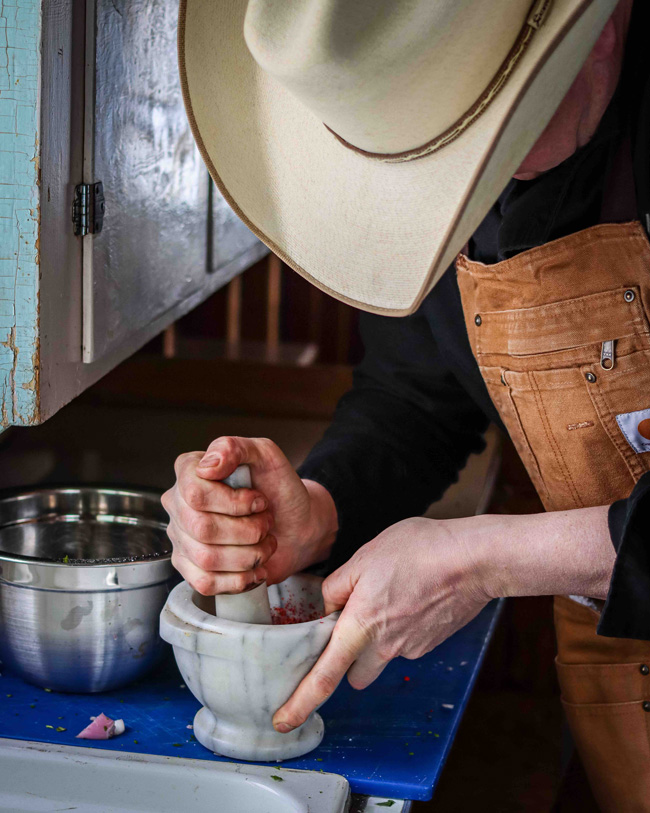
1 Tbsp Crushed Pink Peppercorns
1 Tsp Crushed Chilli Flakes
Crushing up the pink peppercorns.
METHOD
Combine all ingredients in a mixing bowl. Cover and let it sit for at least 30 minutes. Taste and adjust seasoning if needed.
Cook the venison to your preferred doneness.
Plating:
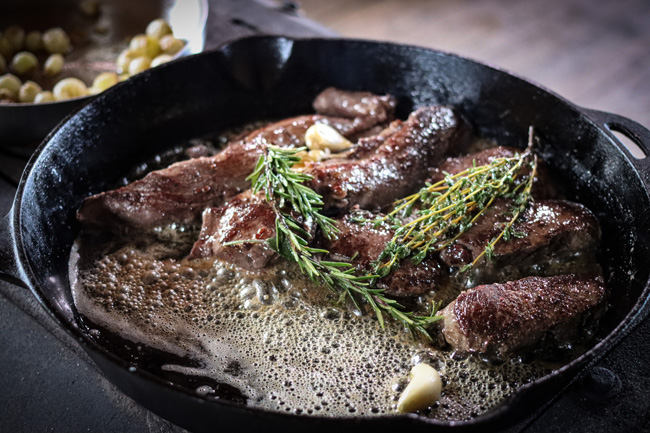
Cook the venison via your preferred method and to your preferred doneness. For this dish we used the tenderloin and seared it at high heat to an internal temperature of 125-degrees Fahrenheit (rare). Then we allowed the meat to rest, covered for 15 minutes.
In the middle of the plate, place your crispy potato pavé, slice your meat to expose its beautiful color and arrange around the potato. Carefully place the roasted onions wherever you feel they should go. Top with a huge spoonful of the chimichurri and enjoy!




.jpg)