


On June 27, 1860, a horse race took place at the Carleton racetrack in Toronto; Don Juan was the winner. It was known as the Queen’s Plate.
One hundred sixty-five years later, Mansetti, an 18-1 longshot, captured the 166th running of the $1-million King’s Plate on August 16, 2025, at Woodbine Racetrack, delivering a stunning victory for trainer Kevin Attard and 20-year-old apprentice jockey Pietro Moran.
In a remarkable performance, Moran guided the bay colt to a near wire-to-wire win, finishing 2 1/2 lengths ahead of Tom’s Magic in a time of 2:03.68, with Notorious Gangster finishing third.
This victory marked the first Plate win for owners Al and Bill Ulwelling and for Moran, who made history by competing against his father, David Moran, in the historic Canadian classic.
Eyes on the Prize
The early roots of horse racing in Canada date back to the 1700s where horses and competition were integral to the culture and life of the Indigenous.
Western lifestyle stimulated ranch-based competitions, which then grew to more organized competitions in larger centres. Competitors often held matches on public roads, and as enthusiasm grew, racing evolved into a regulated industry in the late 19th century.
Eight years after the defeat of French General Joseph-Louis Montcalm by British General James Wolfe on the Plains of Abraham in old Quebec, (a battle during which both generals would be mortally wounded), the very first recorded racing event in Canada was held.
Participants who had registered their horses with Mr. Wilcox at the Market Place for a sum of two dollars, at least two days prior to starting, would be granted the opportunity to compete for a purse of $40.00.
Racing on the pasture owned by Martin Abraham, a fisherman and river pilot on the St. Lawrence, the race took place at precisely 5:00 p.m. on July 1, 1767, exactly 100 years before the establishment of the Dominion of Canada. The victor was a mare by the name of Modesty, owned and ridden by Captain Prescott. Modesty would be inducted into Canada’s Racing Hall of Fame in 2017.
So What’s With the Plate?
As early as the 17th century, (1660-1685), King Charles II began awarding valuable silver plates as racing trophies at Newmarket, the global headquarters of horse racing. Newmarket lies on the border of Suffolk and Cambridgeshire, England, and is home to the Jockey Club where horse racing has been celebrated since the reign of King James I (1603-25). The size of the plate awarded had a direct correlation to the value of the race.
When George I was the King of Great Britain and Ireland between 1714 to 1727, he introduced a racing prize of 50 gold coins, known as guineas. Although the minting of guineas was discontinued in 1813, the tradition of “galloping for the guineas” continues.
As “the eyes on the prize” sought more variety and creativity, prizes evolved; from the early rewards of bridles, and cash purses, to silver plates and gold guineas, other valuable metals were instituted, and the prize took varying forms. The reward was more than the monetary gain. It was an ornamental symbol of victory and prestige over utilitarian function – and the tradition had the more imposing stature due to its link with Royalty.
Introducing the Queen’s Plate
After the historic race on the Plains of Abraham, more races would be organized at that location by the soldiers in the garrisons.
Owning a race horse, even at the expense of economic ruin, was a status symbol many could not ignore, especially among the French Canadian population. The sport of horse racing seemed to take precedence over all over sports, and newspapers thrived on it.
The Quebec Turf Club was initialized in 1789. By the 1830s racing was popular in both Upper (Quebec) and Lower Canada (Ontario), often arranged by officers in the military. In order to gain better horses, both for the purposes of racing and soldiering, better breeding was fundamental.
What better way to encourage the development of horse breeding in Canada, than to offer a Royal Prize to the winner of a prestigious horse race? However, in order to do, one would require the sponsorship and endorsement of the reigning monarchy.
The first Royal race to be held was in honour of King William IV, the reigning monarch between 1830 and 1837. It was the inaugural running of a royal sponsored purse of 100 guineas. The race was restricted to horses bred in Lower Canada (Quebec) and pre-dated the continuous running of the Queen’s Plate in Upper Canada. In 1859 horses from Upper Canada were eligible to complete, and the rivalry was intense.
Consistent with that rivalry, the same year, Casimir Gzowski, President of the Toronto Turf Club, petitioned Sir Edmund Walker Head, then the Governor General of the Province of Canada, for a racing prize to be awarded by the monarchy to horses bred and raised, in what was then Upper Canada.
In agreement with the opportunity to encourage better breeding, Queen Victoria graciously awarded a prize of 50 guineas (21 shillings sterling,) to be awarded annually in a race to be known as the Queen’s Plate. The race was open to any horses reared in Upper Canada which had never won public money.
On June 27, 1860, a five-year old horse by the name of Don Juan, owned by Mr. White, and ridden by Charles Littlefield, would become the first recipient of the Queen’s Plate, competing in three heats over a one-mile track with his best time of 1 minute 58 seconds.
Over the years, that event would evolve to a maximum of 17 three-year-old horses racing in a single heat over 1.25 miles in the oldest continuously-run horse race in America. (Horse racing in Canada continued even through WWI, as the Red Cross held the 59th and 60th runnings of the Queen’s Plate as features of a Red Cross Horse Show to ensure the perpetuity of the race.)
East meets West
Horse racing between eastern and western Canada began to converge in the 1930s, driven by the establishment of major western racing circuits and the expansion of the Canadian Derby.
In 1930, R. James Speers established major racing in the west with the development of the Manitoba Stakes, which would become the Canadian Derby at Polo Park in Winnipeg. By 1936, that event was opened to three-year-olds foaled anywhere in the Dominion of Canada. When Goldlure, the King’s Plate winner in Toronto, traveled 1,300 miles by rail to win the Canadian Derby in Winnipeg in 1937, the two racing worlds converged. While racing had existed in both regions for centuries, regular competition of horses in both areas was primarily facilitated by the high-stake or “plate” races like the Canadian Derby.
Moving further west, informal horse racing already had its roots in Indigenous culture and ranch-based culture. The first formally organized race available to the general public is believed to have taken place in 1884, in the vicinity of Fort Calgary (Calgary, AB). With deep roots in agricultural fair tradition, racing competitions and demonstrations were often the highlight.
The Millarville Fair and Races (Millarville, AB), initiated by early settlers in a nod to the racing traditions in England and Ireland, was first held in June of 1905, making them the oldest in the province. Local ranchers raced their best horses on land donated by a local resident, Raymond DeMalherbe, rent-free for the first 35 years. Steeplechases were added in 1910.
The Calgary Stampede was in its infancy in 1912 and featured various rodeo events and horse races. By 1923, Guy Weadick introduced the chuckwagon races as a means of raising Stampede attendance. They too, incorporated the Thoroughbred, as an integral part of the running. In 1925, legendary Alberta jockey George Woolf of Seabiscuit fame, rode in his first major organized race at the Calgary Stampede.
With the advent of chuckwagon racing, the horse racing histories of the Millarville Fair and the chuckwagons of the Stampede represented two distinct, yet solidly connected, pillars of western heritage. While the Calgary Stampede evolved into a world-renowned commercial venue centered on high-stakes chuckwagon racing, the Millarville Races remained an historical community racing event, rooted in tradition, and remains the oldest in the province. Both events offered significant “purse money” to the winner.
The Calgary Stampede Futurity Stakes
In the fall of 1961, The Calgary Stampede and Exhibition inaugurated the Calgary Stampede Futurity Stakes, as a premier fall event for two-year-old Thoroughbreds. With a sizeable purse of $100,000, it attracted young horses across the country to compete annually from 1961 through to 1996.
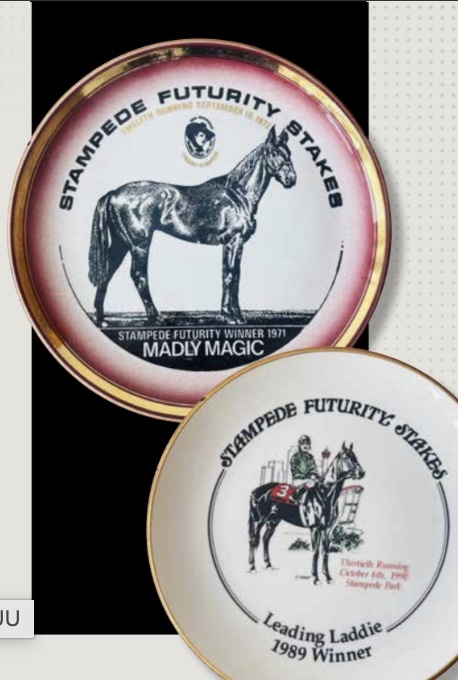
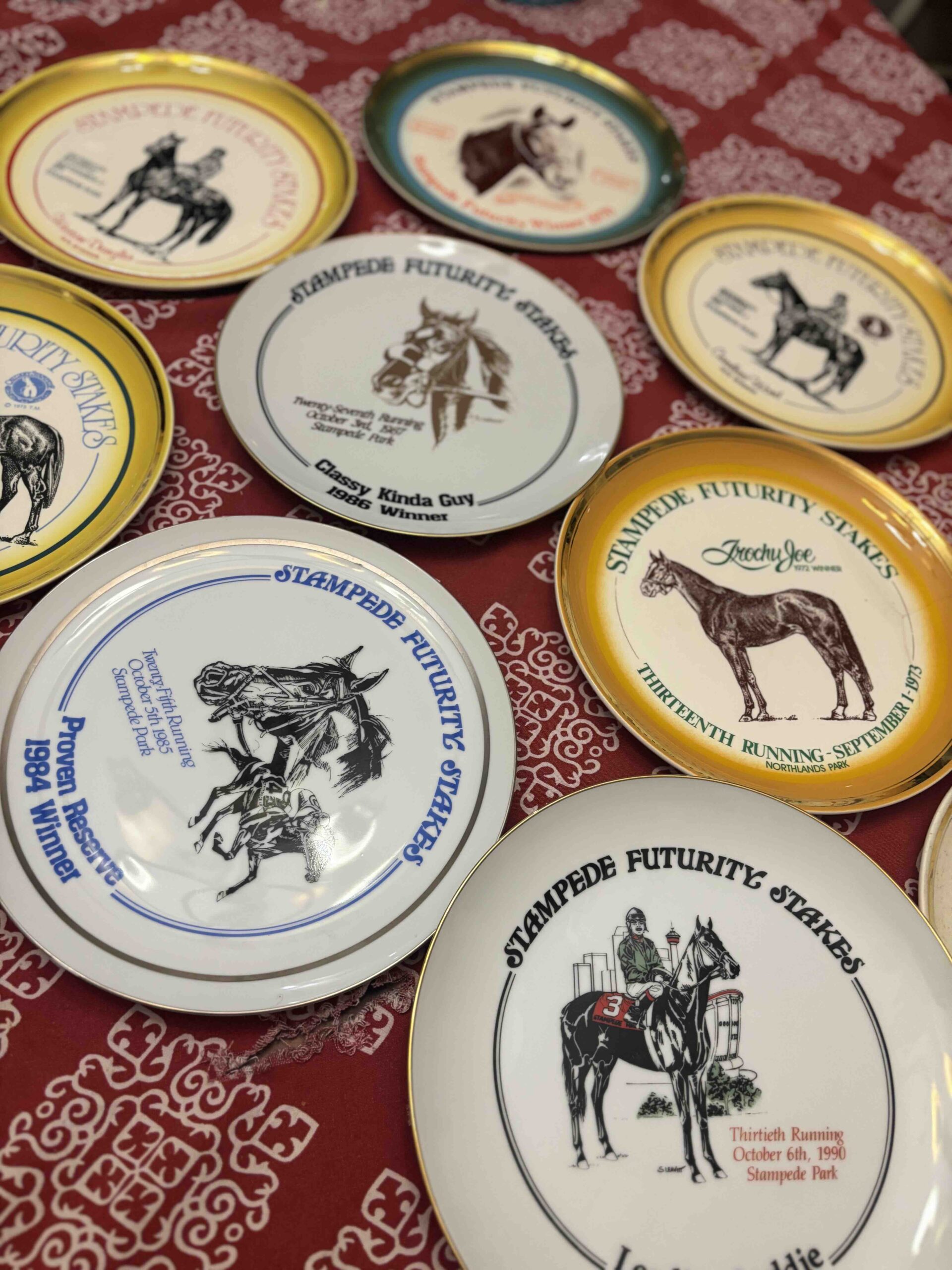
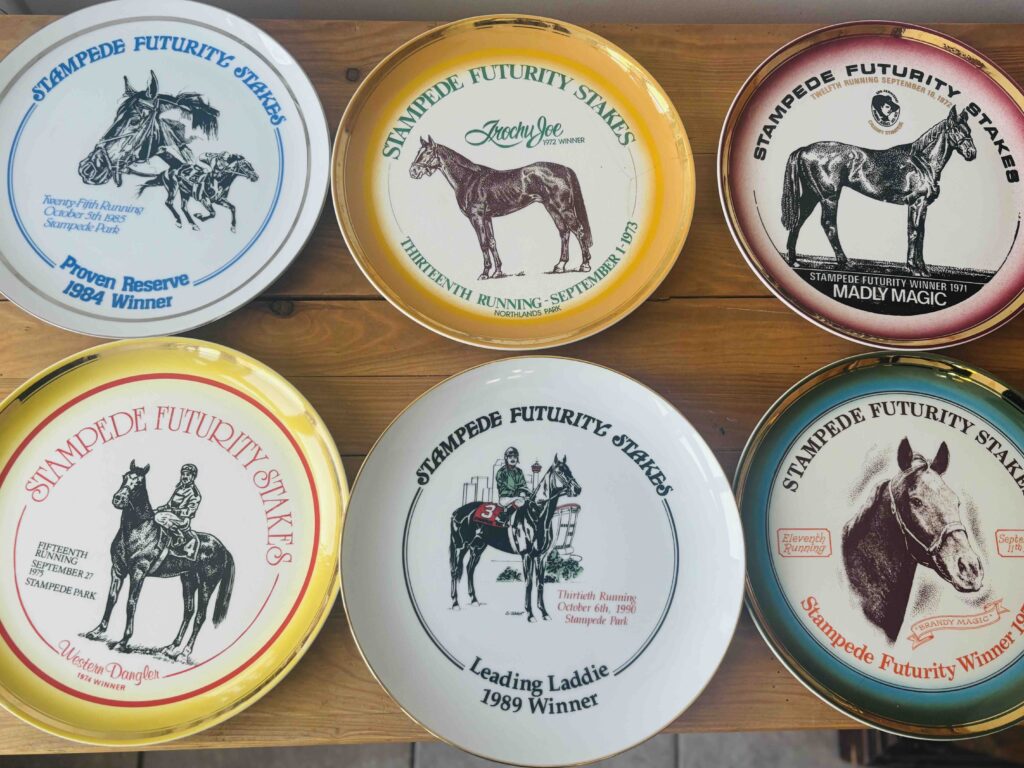
In keeping with the tradition of Royal heritage, commemorative plates were introduced and produced by the Hycroft China Company out of Medicine Hat, Alberta. The factory, initially founded as Medicine Hat Potteries Ltd. was established in 1937-1938 and in itself, was a significant part of western Canadian industrial heritage. The evolution of the Hycroft China Company offered more refined and decorated products than its competitor Medalta Potteries, and was a compelling choice to supply the limited-edition mementos celebrating the annual Stampede Futurity Stakes horse race.
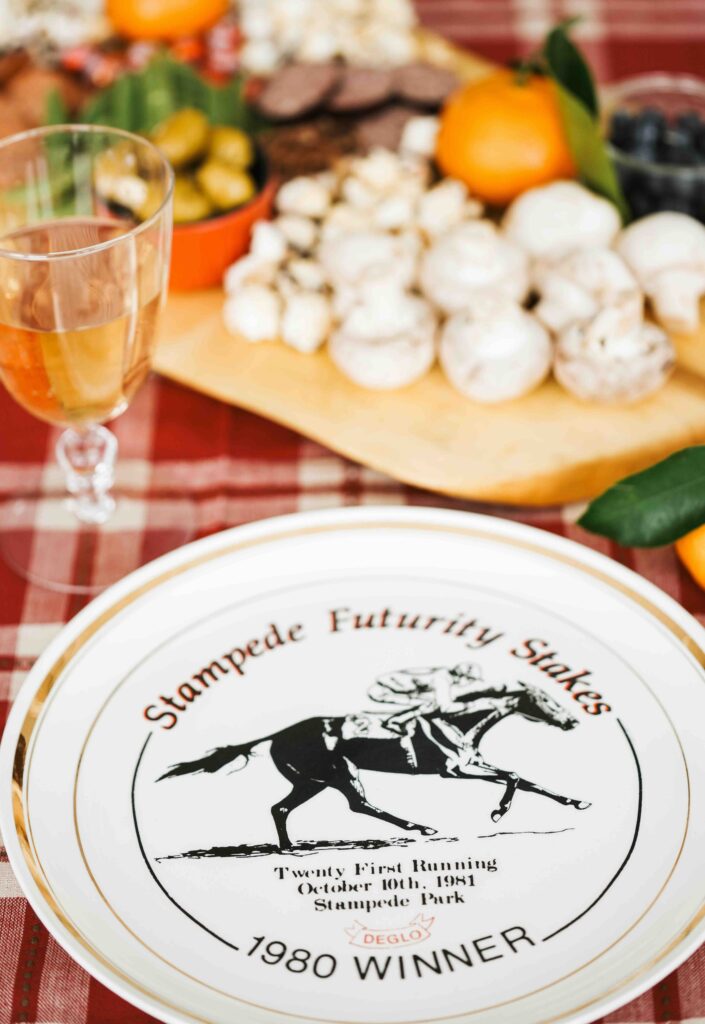
Recognized for their affiliation with Alberta-bred Thoroughbreds, all of the Hycroft plates were produced on a 10.5 inch, flat, rimless concave plate with a distinctive 22K gold trim. Each plate was intended to feature the winning horse and jockey from the prior year, however, in the inaugural running, there was, of course no winner, so the plate featured a green wreath in the shape of a horseshoe.
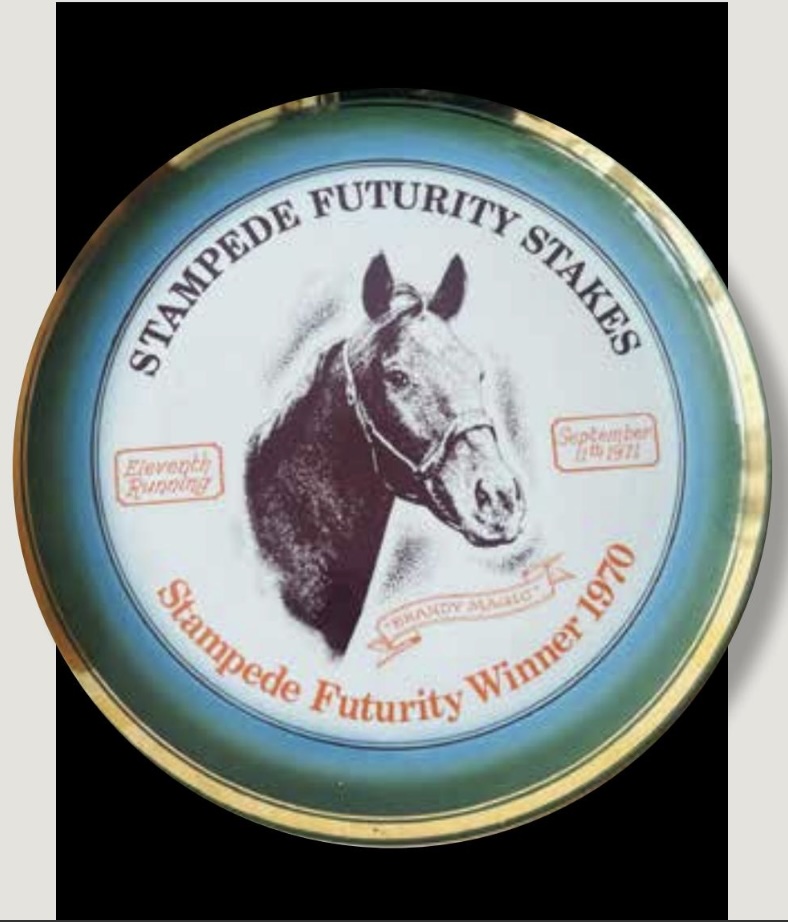
Subsequent plates depicted the name and image of the winning horse sometimes with the jockey, from the previous year, with the number and dates of the running. The plate was generally white with a shaded band around the perimeter, and the horse was imaged in black or brown.
The only way to obtain a plate was to attend the brunch held on race day, or buy it at the gift shop. Attending the brunch ensured you had both a good start to race day and included the plate for the sum of $35.
Although the plates were limited-edition, Hycroft maintained the original silk-screen patterns on hand to ensure they could reproduce them in the case of breakage.
Before producing the actual plate, the Hycroft China Company designed and arranged five or six different layouts to allow the Calgary Stampede to review them to make their selection. Over the years it has been noted that there are few samples of multiple plates for a given year, suggesting perhaps that some may have been part of the unofficial samples submitted, which simply were not returned to Hycroft during production.
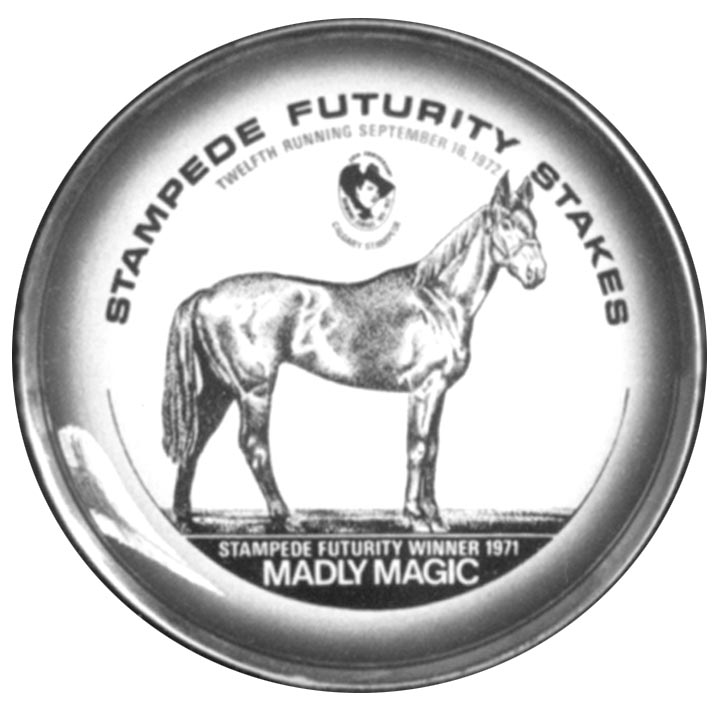
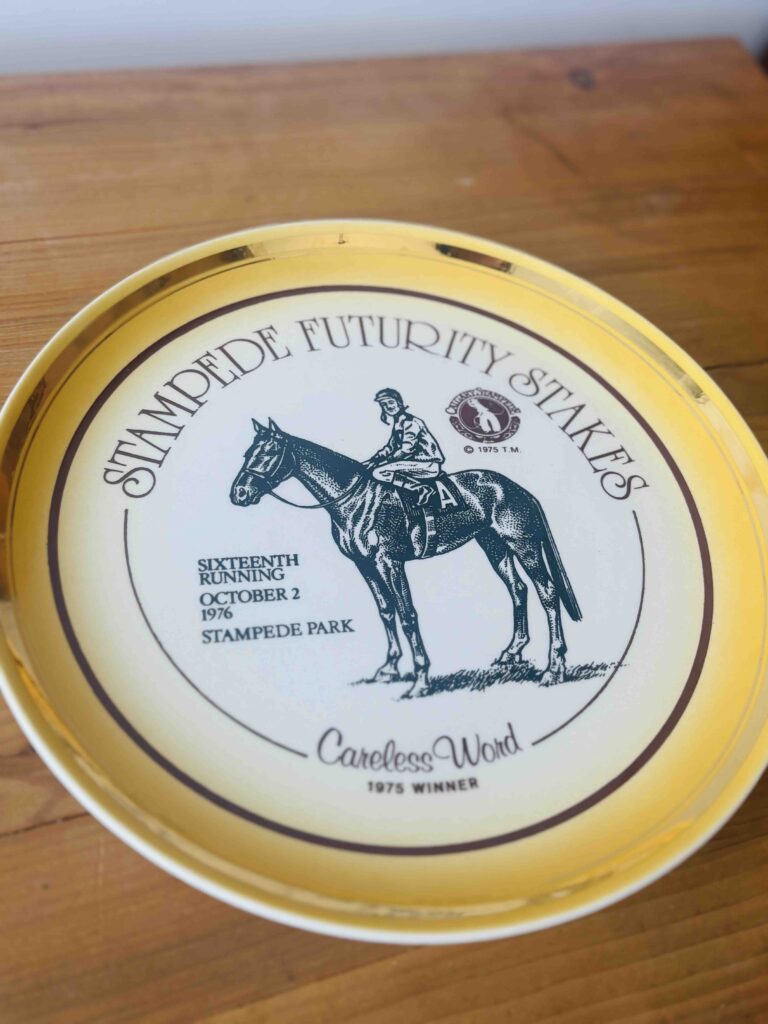
Depending on the popularity of the Futurity Stakes at the time, Hycroft produced numbers ranging from 250 to 500 plates on average. Numbers increased substantially in 1971, featuring Brandy Magic and 1972 depicting Madly Magic, this being the 60th Anniversary – Diamond Jubilee of the Calgary Stampede. Based on sales of $24,500 in 2971, today’s equivalent would be almost $200,000 in plate merchandising!
Over the first 24 years during which Hycroft produced the plates, a number of artists were commissioned, including an Alberta/Arizona artist by the name of Sandra (Leavitt) Hayes. Well-loved for her warm and caring personality, Hayes designed several of the Stampede Futurity plates.
Passing in 2024, Hayes has left a legacy of her art and friendships in the racing world.
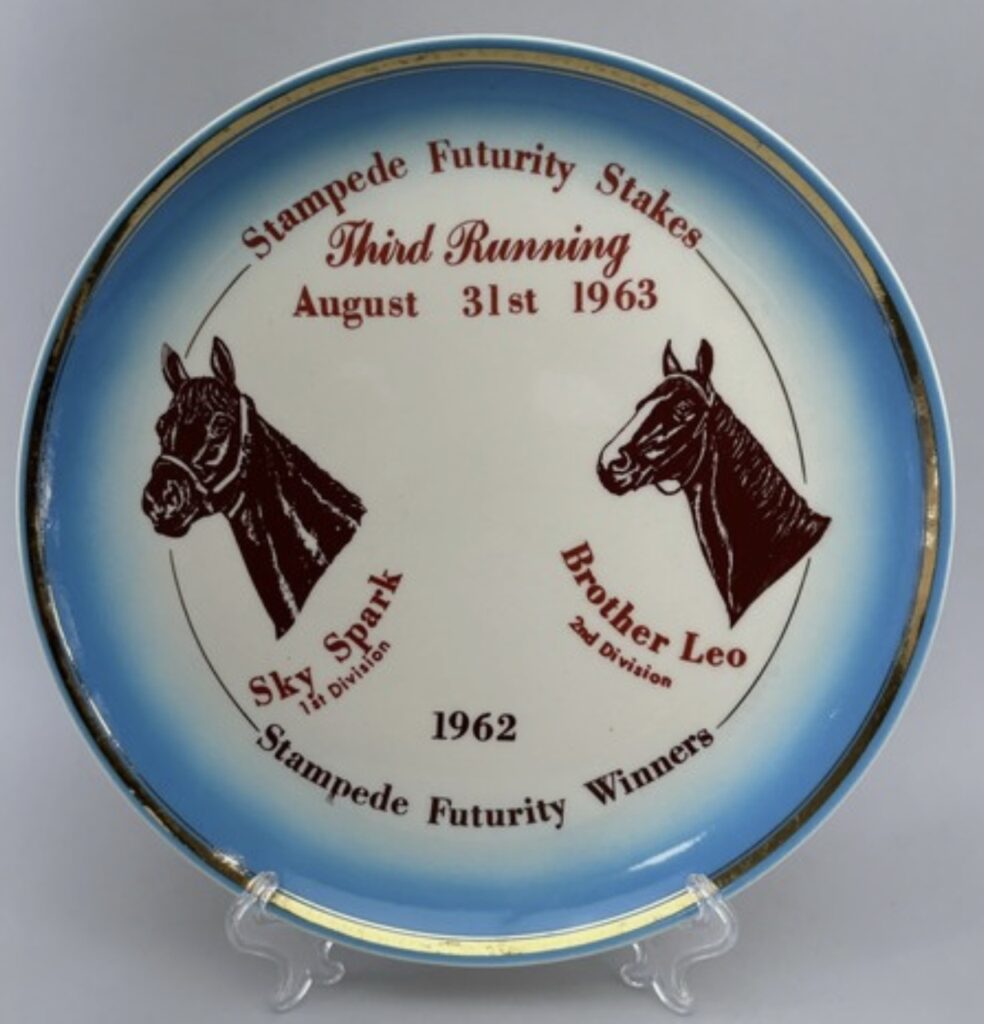
Several of the plates feature two images, some of the horse, and the horse and jockey, and some with the First and Second Division winners.
The 1963 Futurity Plate, Third Running, depicts two winners from 1962, Sky Spark in the First Division and Brother Leo (Second Division). Based on records from Hycroft, between 1961 and 1975, at least three of the races listed two horses, noting first and second division winners.
Ultimately, the plate is the symbol of victory, the race to the finish line, and the glory of the win.